Jun 15, 2026
How Archaius’ innovation campaign inside the world’s most contested electronic warfare environment provides direct feedback critical to ensuring survivable unmanned aerial operations and equipping warfighters for the rapidly evolving battlespace.
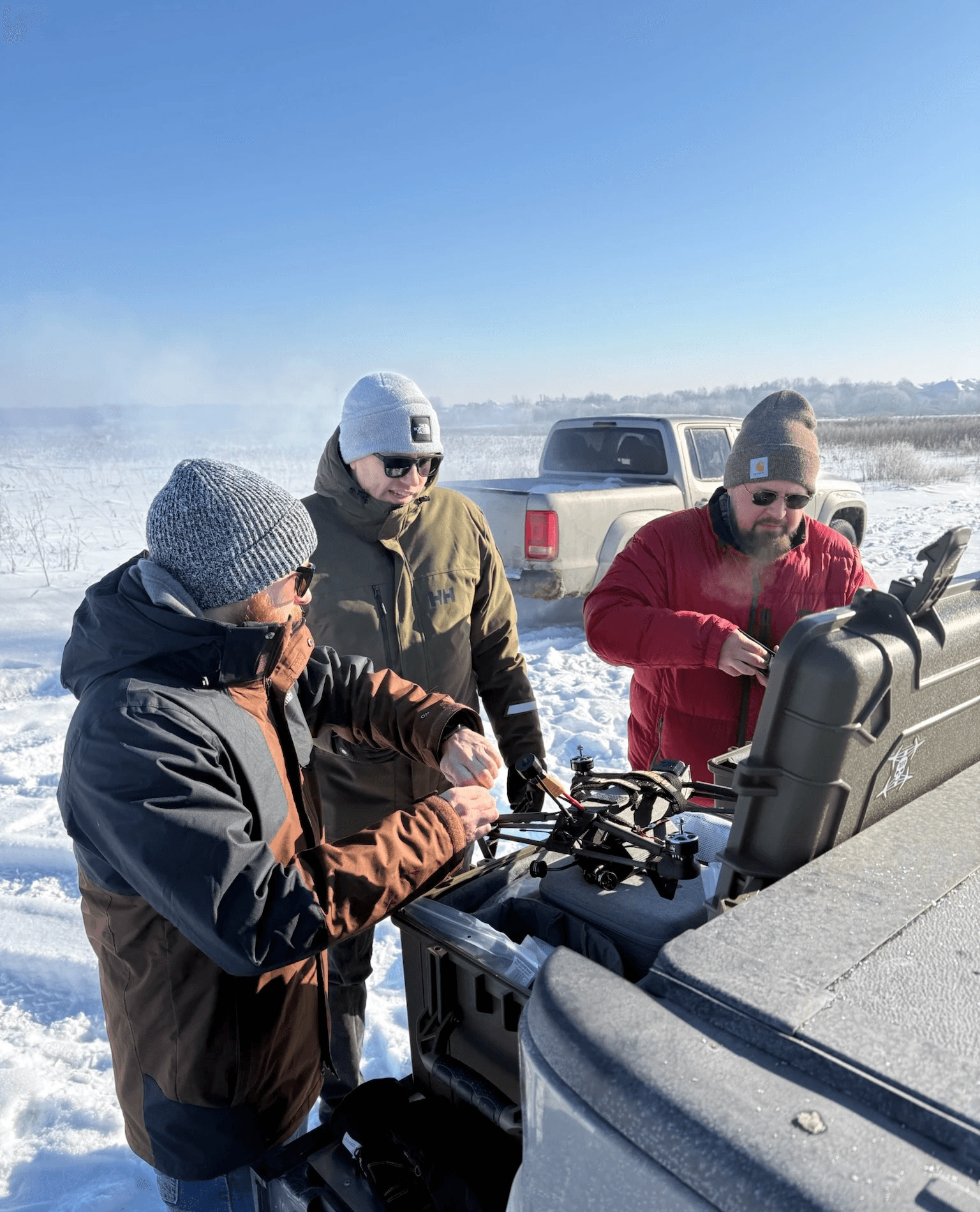
Durham, North Carolina – Winter/Spring 2026 – Archaius celebrates a meaningful operational milestone as the company continues to drive innovation and advance its signals assurance mission through a sustained presence in Ukraine. The launch of a structured testing campaign in such a highly contested electromagnetic environment enables the company to validate its anti-jamming capability alongside Ukraine's drone operators, who both face and create novel electronic warfare threats daily. This validation establishes Grale as a proven solution for the warfighter where other systems fail.
Ukraine has become the world’s most active proving ground for unmanned systems. Operators develop and refine drone tactics in a rapid innovation cycle fed by sustained, sophisticated electronic attack. As US defense companies seek to perform in the EMS-denied environments that now define modern conflict, Ukraine has become the reference point for performance. Archaius takes that a step further, adopting a philosophy that resilience solutions must be validated by the forces using them, under active operational conditions.
What began as an exploratory engagement in Ukraine rapidly evolved into an intensive, six-phase Test and Evaluation campaign remotely managed by Archaius engineers in Durham, NC. Limited on-site personnel are conducting three range days and two lab days per week in the current campaign phase. The team successfully completed more than 40 range days through mid-May, testing Archaius’ Grale command-and-control protection module against a broad spectrum of signal jamming threats using omnidirectional, directional, and simultaneous configurations. At power levels up to 200 watts, distances approaching four kilometers, and speeds ranging from 10 to 60 mph, these tests generate highly structured and informative data that directly strengthens the next generation of Grale development.
By the Numbers
40+ range days completed through mid-May
10 jammer types across multiple active military units
15+ flight controllers and 20+ drone models integrated
Testing conducted at power levels up to 200W and distances up to 4km
15–45 flights per range day
How does Archaius ensure anti-jamming in contested environments?
Every test Archaius conducts involves operators, engineers, and electronic warfare systems coordinated through active Ukrainian commercial or military partners. During preparation for range days, the testing and evaluation team collaborates with partner engineers to integrate their technology with Grale, demonstrating the product’s value to end users seeking a low-cost, modular, and highly effective signals assurance solution.
During the onsite testing phase, the team of Archaius personnel and Ukrainian engineers, pilots, and operators conducts between 15-45 flights a day, occurring in large, open areas from the outskirts of major cities to the fringes of the front lines. Grale consistently performs under a variety of weather conditions, including rain and extreme temperatures. By testing in these strategically selected environments, Archaius can integrate with separately trained drone units and simulate the warfighter experience.
How are Grale’s capabilities validated?
Grale has been integrated with more than 15 unique flight controllers and over 20 drone models, ranging from 7”-15” quadcopters, primarily Group 1 drones. The team has also mounted Grale to state-of-the-art drones, including advanced FPV platforms equipped with optical stabilization systems that further enhanced and validated Grale’s ability to maintain positioning -- even in fully denied environments.
Grale has been flown against ten different jammers sourced from several different Ukrainian units to date, ranging from widely available vehicle jammers to strategic systems with advanced modulations and highly directional antennas.
Flight sequences are constructed to test Grale’s capabilities: using different flight routes to simulate an attack on the jammer platform and manipulating transmission power, directionality, and approach distance. Using low power and increased distances, teams can simulate greater operational separation between operators and their targets, thus validating Grale’s ability to execute without placing the warfighter in harm's way. Engagement with such a range of partners, technology, and conditions maximizes product exposure and generates direct user feedback regarding what operators truly need from anti-jamming and signals assurance technology.
Building upon partnerships established by Archaius engineers in-country at the close of 2025, the company has maintained a steady operational presence in Ukraine since January. Upon exposure to Grale and its capabilities, Archaius’ partners have expressed confidence “that integration of Grale C2 systems would enable drones to attack targets currently unreachable” and excitement “to continue working with Archaius for future testing at extended ranges.” Ultimately the campaign has fostered strong interest “in collaborating to develop an EW resilience program” for the existing customer base in Ukraine.
Why does presence in the EW battlespace matter?
Archaius operates on a unique, integrity-driven validation philosophy aimed at constructing a strong end-user feedback pipeline and tight iteration cycle between field observation and product development. Operations in Ukraine have not only demonstrated Grale's capability to consistently maintain link integrity under direct attack, but also enabled the Archaius team to gain irreplicable insight into the most critical battlefield challenges engineers and operators face.
The war in Ukraine has fundamentally reshaped the electromagnetic battlespace, forcing military personnel to rapidly adapt capabilities and tactics. Electronic warfare now routinely denies traditional battlespace awareness, forcing unmanned systems to operate in EMS-denied environments where conventional intelligence, surveillance, and reconnaissance (ISR) has been degraded or lost. Establishing a comprehensive understanding of these challenges is critical to Archaius' development roadmap and ability to support commanders’ decision-making by providing technology tailored to combat conditions.
What are the long-term impacts of this campaign?
Through each testing phase in Ukraine, Archaius is assembling the foundations for full Grale integration across Ukrainian drone platforms. The campaign in Ukraine is ultimately designed to enable Ukrainian-led, Grale-enabled operations independent of Archaius personnel. This transition will solidify an innovation pipeline and ensure Archaius’ ability to integrate efficiently and in close proximity to the end-user for many years to come.
"Ukraine did not ask for this war, but they have faced it with remarkable determination, resilience, and skill,” says CEO James Upson. “Archaius is honored to work alongside Ukrainian warfighters, learning as much from them as we have contributed. That spirit of mutual respect and co-development is the foundation of everything we build. The impacts of this campaign extend far beyond Ukraine—as our adversaries export the lessons learned from its battlefield globally, so too must we."
Archaius recognizes that real power is generated through co-development and remains committed to delivering utility through partnerships. The need for effective signals assurance is extensive across industries and even continents. Archaius is eager to leverage the success achieved in Ukraine to expand our technology integration to users worldwide, establishing Grale as the standard in signal resilience and connectivity & capability continuity.
Last updated June 15